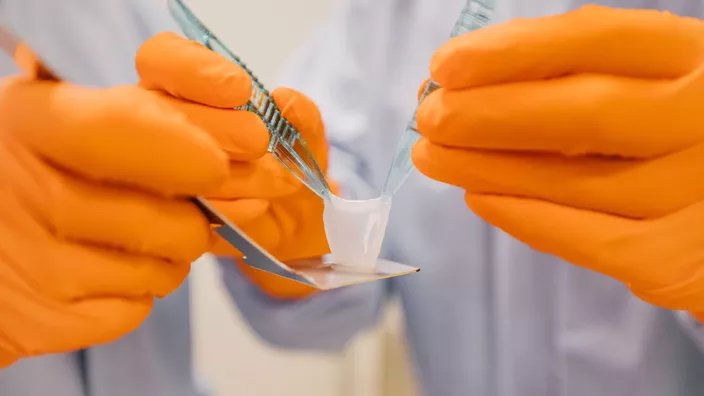
The French pharmaceutical company Urgo has announced a breakthrough it describes as a world first: the creation in the laboratory of a living, cryopreserved artificial skin ready for transplantation onto patients suffering from severe burns. This innovation, developed within the framework of the Genesis project launched in 2021, is the result of a consortium bringing together several major players in French research, including the CNRS (French National Centre for Scientific Research), the French Blood Establishment (EFS), and Dassault Systèmes.
With a budget of €100 million, including €22.8 million in public funding, the program aims to address one of the main challenges in reconstructive medicine: offering an alternative to autografts, which currently require harvesting healthy skin from the patient to treat the most severe injuries.
According to its developers, this next-generation skin is created from so-called "universal" cells, organized in three dimensions to closely replicate the structure and functions of human skin. One of the technology's remarkable achievements lies in its ability to be stored at very low temperatures and then thawed while preserving living, functional cells.
Researchers believe this breakthrough could transform the treatment of burn victims and patients with severe wounds by reducing surgical procedures, the pain associated with skin grafting, and lengthy hospital stays. While this scientific milestone marks a major turning point, the technology will still need to undergo clinical trials before potential large-scale use. The first patients could be enrolled in a clinical study around 2030, with industrial deployment anticipated in the following decade.
 Sophie de Duiéry
|
 20/11/2026 |
















































 Anglais
 Arabic
 Deutsch
 Français
 Español
 Italien
 Português
 Russian